Sweden's SAAB has signed a $12 million contract for the delivery of the RBS 70 Very Short Range Air Defense (VSHORAD) missile system to Brazil starting this year. This makes Brazil the nineteenth country where the RBS 70 will enter service.
The purchase is another win for Sweden and comes after Brazil had previously selected Sweden's Gripen as its preferred choice for fighter aircraft over candidates from France and the United States, the Rafale and F/A-18 respectively. The RBS 70 in turn was selected over other candidates such as the Russian SA-18/24.
Besides the RBS 70 launchers and MK II type missiles, the contract includes simulators, night
vision equipment, spare parts, test and maintenance equipment, training and other related support. The RBS 70 can come in several configurations such as mounted on various vehicles or dismounted on a tripod.
The MK II version features several improvements over previous versions which began entering service during the late seventies such as increased speed, longer range and a new shaped-charge warhead with a proximity fuse. A more updated and improved system is known as the RBS 70 NG.
Showing posts with label Air Defense. Show all posts
Showing posts with label Air Defense. Show all posts
Wednesday, March 5, 2014

Thursday, January 30, 2014
Oman Buys NASAMS Air Defense System
Oman has signed a $1.28 billion contract for the purchase of the National Advanced Surface-to-Air Missile System (NASAMS). It was selected over a competing offer from Europe's MBDA and included in the contract are ground support equipment, training and technical support.
The short-to-medium range surface-to-air missile defense system is able to defend against a range of aerial threats such as aircraft, unmanned aerial vehicles, cruise missiles and high precision munitions.
Initially developed by Raytheon in the United States and Norway's Kongsberg to meet Norway's defense needs as its launch customer, it has since been marketed to other countries and has been adopted by the US, Netherlands, Spain and Finland.
The system was the first application of the surface-launched version of the Advanced Medium-Range Air-to-Air Missiles (SL AMRAAM), but it's also compatible with other surface-launched missiles such as the Evolved Sea Sparrow Missiles (ESSM) and the Sidewinder Missiles.
The short-to-medium range surface-to-air missile defense system is able to defend against a range of aerial threats such as aircraft, unmanned aerial vehicles, cruise missiles and high precision munitions.
Initially developed by Raytheon in the United States and Norway's Kongsberg to meet Norway's defense needs as its launch customer, it has since been marketed to other countries and has been adopted by the US, Netherlands, Spain and Finland.
The system was the first application of the surface-launched version of the Advanced Medium-Range Air-to-Air Missiles (SL AMRAAM), but it's also compatible with other surface-launched missiles such as the Evolved Sea Sparrow Missiles (ESSM) and the Sidewinder Missiles.
Saturday, November 16, 2013
Japan Plans to Strengthen Defenses by Acquiring 2 Additional Aegis Destroyers
The Japanese Defense Ministry has expressed its plans to supplement its six existing Kongo and Atago class destroyers with two additional units, which like their predecessors will also feature the Aegis system.
Japan currently has four Kongo class destroyers, which are roughly based on the Arleigh Burke class and two improved versions known as the Atago class. The Kongo class ships were commissioned between 1993 and 1998 and the Atago class between 2007 and 2008.
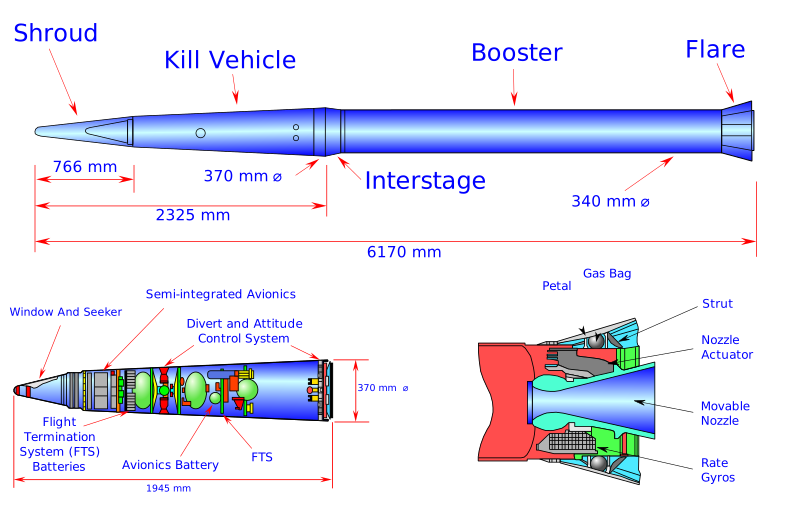
The two new ships will be fitted with hit-to-kill SM-3 missiles to defend against ballistic missile attacks. Both the current SM-3 Block 1A and the next-generation SM-3 Block IIA, a joint development between Japan and the United States, will be integrated.
The SM-3 Block IIA recently completed its design phase and is expected to be available for testing in 2015. The new version will feature the ability to intercept longer-range ballistic missiles and from further out than is currently possible with the existing SM-3 Block 1A/B.
Japan currently has four Kongo class destroyers, which are roughly based on the Arleigh Burke class and two improved versions known as the Atago class. The Kongo class ships were commissioned between 1993 and 1998 and the Atago class between 2007 and 2008.
The two new ships will be fitted with hit-to-kill SM-3 missiles to defend against ballistic missile attacks. Both the current SM-3 Block 1A and the next-generation SM-3 Block IIA, a joint development between Japan and the United States, will be integrated.
The SM-3 Block IIA recently completed its design phase and is expected to be available for testing in 2015. The new version will feature the ability to intercept longer-range ballistic missiles and from further out than is currently possible with the existing SM-3 Block 1A/B.
Wednesday, October 16, 2013
UK Orders 200 Starstreak Surface-to-Air Missiles
The United Kingdom has ordered 200 Starstreak Surface-to-Air Missiles from Thales for Very Short-Range Air Defense (VSHORAD). They are to be delivered in 2014 to increase existing stocks.
The Starstreak High Velocity Missile stands out by taking a different design approach compared to other contemporary missiles by among others utilizing semi-automatic line-of-sight laser beam riding.
It is very different from designs developed by other countries such as the United States, Russia and China. Notable differences include:
The Starstreak High Velocity Missile stands out by taking a different design approach compared to other contemporary missiles by among others utilizing semi-automatic line-of-sight laser beam riding.
It is very different from designs developed by other countries such as the United States, Russia and China. Notable differences include:
- With a maximum speed of Mach 3.5, the Starstreak is almost twice as fast as its competitors which usually travel below Mach 2.
- Starstreak missiles are laser-beam riders, unlike others that often rely on a infrared seeker for guidance.
- The Starstreak uses submunitions with three darts, unlike other missiles with unitary warheads.
Friday, September 27, 2013
Turkey Selects Chinese HQ-9 / FD-2000 Surface-to-Air Missile Air Defense System For T-LORAMIDS
Turkey has decided to select as winner the HQ-9 / FD-2000 Surface-to-Air Missile (SAM) Air Defense System from China Precision Machinery Import-Export Corp (CPMIEC) for the T-LORAMIDS project that is to provide Turkey with long-range air defense against aircraft and missiles that it currently lacks.
CPMIEC is to collaborate with Turkey to produce a variant of the HQ-9 / FD-2000 locally after delivery of the initial systems. The other losing contenders in the tender were Russia's S-300, the Patriot system from the United States and the Eurosam SAMP/T Aster 30 from France and Italy.
Turkey's NATO partners had tried to dissuade it from selecting the Chinese system after Turkey had said that it was leaning towards the Chinese option by warning that they might not cooperate in integrating the FD-2000 with existing systems that are mostly western in origin.
Despite western objections, Turkey's Defense Industry Executive Committee, which is in charge of major procurement decisions and headed by the Prime Minister, still decided that the FD-2000 was the best fit for its needs.
CPMIEC is to collaborate with Turkey to produce a variant of the HQ-9 / FD-2000 locally after delivery of the initial systems. The other losing contenders in the tender were Russia's S-300, the Patriot system from the United States and the Eurosam SAMP/T Aster 30 from France and Italy.
Turkey's NATO partners had tried to dissuade it from selecting the Chinese system after Turkey had said that it was leaning towards the Chinese option by warning that they might not cooperate in integrating the FD-2000 with existing systems that are mostly western in origin.
Despite western objections, Turkey's Defense Industry Executive Committee, which is in charge of major procurement decisions and headed by the Prime Minister, still decided that the FD-2000 was the best fit for its needs.
Wednesday, September 18, 2013
Belarus to Receive Third Battery of Almaz-Antei Tor-M2 / SA-15 From Russia
According to the Belarusian Defense Minister Yuri Zhadobin, Russia will deliver the third battery of short-range Almaz-Antei Tor-M2 / SA-15 Surface-to-Air Missiles Air Defense Systems before the end of 2013.
The Tor family of SAMs can be used to defend against aircraft, helicopters, unmanned aerial vehicles, cruise missiles, precision-guided munitions and even some ballistic targets.
Belarus already has two batteries of Tor M2 which were delivered in 2011 and 2012. A Tor-M2 battery is supposed to consist of:
The Tor family of SAMs can be used to defend against aircraft, helicopters, unmanned aerial vehicles, cruise missiles, precision-guided munitions and even some ballistic targets.
Belarus already has two batteries of Tor M2 which were delivered in 2011 and 2012. A Tor-M2 battery is supposed to consist of:
- Four Transporter Erector Launcher And Radar (TELARs)
- One mobile command post
- Various support vehicles
Tuesday, September 17, 2013
Singapore to Buy Eurosam Aster 30 / SAMP-T Surface-to-Air Missile Air Defense System
According to Singapore's Defense Minister Ng Eng Hen, the Republic of Singapore Air Force (RSAF) will acquire the Eurosam Aster 30 / SAMP-T Surface-to-Air Missile (SAM) Air Defense System to establish a multi-layered defense against aerial threats.
If Singapore goes ahead and signs a contract, Singapore will become the first export customer of the Aster 30 / SAMP-T system, which is currently only in service with France and Italy. Both countries and the United Kingdom also use the naval version of the Aster 30 SAM.
The Defense Minister did not say when or how many systems Singapore intends to acquire, but Singapore already uses the shorter ranged Aster 15 with its six Formidable class frigates it bought from France and which are compatible with the Aster 30 SAM.
The Aster 30 / SAMP-T system will replace the American HAWK system and will be complemented by the short-range SPYDER system which Singapore acquired earlier from Israel.
If Singapore goes ahead and signs a contract, Singapore will become the first export customer of the Aster 30 / SAMP-T system, which is currently only in service with France and Italy. Both countries and the United Kingdom also use the naval version of the Aster 30 SAM.
The Defense Minister did not say when or how many systems Singapore intends to acquire, but Singapore already uses the shorter ranged Aster 15 with its six Formidable class frigates it bought from France and which are compatible with the Aster 30 SAM.
The Aster 30 / SAMP-T system will replace the American HAWK system and will be complemented by the short-range SPYDER system which Singapore acquired earlier from Israel.
Sunday, September 15, 2013
Russia Will Receive Almaz-Antei S-350E Vityaz (50R6) in 2016
Almaz-Antei plans to start delivering the first of its S-350 Vityaz (50R6) surface-to-air missile (SAM) air defense system now in development in 2016. The S-350 Vityaz will replace the earliest versions of the S-300 such as the S-300PS.
While technically a new system, the S-350 Vityaz makes heavy use of components that had been developed earlier. It is a lighter and scaled down version of the S-400 which it will complement.
The S-350 also incorporates lessons from South Korea's KM-SAM Cheongung which Almaz-Antei helped co-develop. The S-350 Vityaz system consists of:
While technically a new system, the S-350 Vityaz makes heavy use of components that had been developed earlier. It is a lighter and scaled down version of the S-400 which it will complement.
The S-350 also incorporates lessons from South Korea's KM-SAM Cheongung which Almaz-Antei helped co-develop. The S-350 Vityaz system consists of:
- 50K6E command post
- 50H6E phased-array radar system
- 50P6E transporter-erector launcher (TEL)
Friday, September 13, 2013
Sea Ceptor / CAMM(M) Missile Launched From MK41 VLS and Awarded Contract by UK
The United Kingdom has awarded a 250 million pound or roughly $393 million contract for the manufacture of Sea Ceptor missiles, which are the maritime component of the Common Anti-Air Modular Missile (CAMM) consisting of:
The Sea Ceptor manufactured by MBDA will first enter service with the Type 23 frigate replacing the Sea Wolf missile and later on the Type 26 Global Combat Ship when they replace the Type 23 ships currently in service after 2020.
In the Army, it could be used as a vertically launched surface-to-air missile system, where it will replace the short-range Rapier system. In the Air Force, it could replace the current ASRAAM air-to-air missile.
- CAMM(A): Air component
- CAMM(L): Land component
- CAMM(M): Maritime component
The Sea Ceptor manufactured by MBDA will first enter service with the Type 23 frigate replacing the Sea Wolf missile and later on the Type 26 Global Combat Ship when they replace the Type 23 ships currently in service after 2020.
In the Army, it could be used as a vertically launched surface-to-air missile system, where it will replace the short-range Rapier system. In the Air Force, it could replace the current ASRAAM air-to-air missile.
Wednesday, September 11, 2013
China Testing BK1060 8X8 35MM SPAAG
China has recently revealed on state television another addition to its family of 8x8 wheeled vehicles, which includes the ZBL09 Infantry Fighting Vehicle and other assorted types.
The BK1060, which has yet to enter operational service and does not carry a PLA designation, is to perform the role of very short-range air defense as a Self-Propelled Anti-Aircraft Gun with sufficient mobility to keep up with mobile formations.
Unlike the tracked PGZ07 with its dual 35 mm guns, the wheeled BK1060 carries a single 35 mm gun. The guns are derived from the towed PG99, which itself is based on the 35 mm guns originally developed by Oerlikon Contraves.
The Chinese army is standardizing around the 35 mm caliber for new development in place of the older 37 mm and to a certain extent the 25 mm. However, both the 37 mm and 25 mm will continue to be used with existing units for many years still.
The BK1060, which has yet to enter operational service and does not carry a PLA designation, is to perform the role of very short-range air defense as a Self-Propelled Anti-Aircraft Gun with sufficient mobility to keep up with mobile formations.
Unlike the tracked PGZ07 with its dual 35 mm guns, the wheeled BK1060 carries a single 35 mm gun. The guns are derived from the towed PG99, which itself is based on the 35 mm guns originally developed by Oerlikon Contraves.
The Chinese army is standardizing around the 35 mm caliber for new development in place of the older 37 mm and to a certain extent the 25 mm. However, both the 37 mm and 25 mm will continue to be used with existing units for many years still.
Friday, June 14, 2013
Iran Rejects Tor As Replacement For S-300 Air Defense System
Iran has rejected a Russian proposal to substitute the Tor (NATO: SA-15) short-range air defense system for the S-300 (NATO: SA-10) long-range air defense system.
Iran had originally ordered the S-300-PMU1 in 2007. The $800 million contract was then cancelled by Russia in 2010. In 2011, Iran launched a $4 billion lawsuit against Russia over the cancellation.
Iran insists that Russia fulfill the original contract and deliver the S-300 as agreed. It will only withdraw the lawsuit when Russia agrees to honor the contract that was signed.
While Iran has yet to receive the S-300, it already has the Tor-M1 system. In 2005, 29 Tor-M1 systems were ordered for $700 million. All were delivered by 2007.
The Tor-M1 is a short-range, all-weather, surface-to-air missile air defense system that can engage aircraft, unmanned aerial vehicles, cruise missiles and other precision guided munitions.
The tracked Tor-M1 vehicle carries 8 vertically cold-launched 9M331 missiles. Each 9M331 has a:
The latest version, the Tor-M1 features a number of improvements, including:
http://en.ria.ru/world/20130610/181598186/Iran-Rejects-Russias-S-300-Substitute-Offer.html

Iran had originally ordered the S-300-PMU1 in 2007. The $800 million contract was then cancelled by Russia in 2010. In 2011, Iran launched a $4 billion lawsuit against Russia over the cancellation.
Iran insists that Russia fulfill the original contract and deliver the S-300 as agreed. It will only withdraw the lawsuit when Russia agrees to honor the contract that was signed.
While Iran has yet to receive the S-300, it already has the Tor-M1 system. In 2005, 29 Tor-M1 systems were ordered for $700 million. All were delivered by 2007.
The Tor-M1 is a short-range, all-weather, surface-to-air missile air defense system that can engage aircraft, unmanned aerial vehicles, cruise missiles and other precision guided munitions.
The tracked Tor-M1 vehicle carries 8 vertically cold-launched 9M331 missiles. Each 9M331 has a:
- Length of 2900 mm
- Diameter of 235 mm
- Weight of 167 kg
- Warhead of 15 kg
- Speed of 850 m/s
- Range of 12000 m
- Ceiling of 6000 m
The latest version, the Tor-M1 features a number of improvements, including:
- new phased array radar
- improved missiles
- improved electronic counter measures
- improved infrared tracking system
- increase in the number of targets that can be engaged simultaneously
http://en.ria.ru/world/20130610/181598186/Iran-Rejects-Russias-S-300-Substitute-Offer.html

Saturday, June 1, 2013
Russia Trying To Convince Iran To Withdraw S-300-PMU1 Lawsuit
Russia is trying to convince Iran to withdraw a lawsuit against the cancellation of a contract to supply Iran with S-300-PMU1 (NATO: SA-10) Surface-to-Air Missile (SAM) Air Defense Systems. So far, the efforts have not been successful.
In 2007, Iran and Russia signed a $800 million contract for the delivery of five S-300-PMU1 battalions. In 2010, this contract was cancelled by Russia due to UN Security Council Resolution 1929.
This resolution bans the supply to Iran of conventional weapons, including missiles, tanks, attack helicopters, warplanes and ships. However, Iran is convinced that the S-300 SAM is exempt because they are considered defensive weapons.
Iran then proceeded in 2011 to file a $4 billion lawsuit against Russia in an international arbitration court in Switzerland. Iran has states that it will only withdraw the lawsuit if Russia fulfills the terms of the contract.
Meanwhile, Russia is sending mix signals about the delivery of S-300 SAM systems to Syria. Delivery of the S-300 systems is scheduled to begin in the very near future.
However, Russia has stated that it is willing to delay deliveries under the condition that the West complies with some of Russia's demands regarding Syria.
Russia has also warned that it could accelerate deliveries of the S-300 if its demands are not met. From its standpoint, Syria could use the S-300 to defend itself against foreign aggression.
With Russia using deliveries of the S-300 as a negotiating tactic, Israel for its part has stated that it reserves the right to prevent Syria from receiving any new weapons, including the S-300, by force if necessary.
http://en.ria.ru/military_news/20130531/181432861/Russia-Seeks-Amicable-Settlement-in-Iran-S-300-Lawsuit.html

In 2007, Iran and Russia signed a $800 million contract for the delivery of five S-300-PMU1 battalions. In 2010, this contract was cancelled by Russia due to UN Security Council Resolution 1929.
This resolution bans the supply to Iran of conventional weapons, including missiles, tanks, attack helicopters, warplanes and ships. However, Iran is convinced that the S-300 SAM is exempt because they are considered defensive weapons.
Iran then proceeded in 2011 to file a $4 billion lawsuit against Russia in an international arbitration court in Switzerland. Iran has states that it will only withdraw the lawsuit if Russia fulfills the terms of the contract.
Meanwhile, Russia is sending mix signals about the delivery of S-300 SAM systems to Syria. Delivery of the S-300 systems is scheduled to begin in the very near future.
However, Russia has stated that it is willing to delay deliveries under the condition that the West complies with some of Russia's demands regarding Syria.
Russia has also warned that it could accelerate deliveries of the S-300 if its demands are not met. From its standpoint, Syria could use the S-300 to defend itself against foreign aggression.
With Russia using deliveries of the S-300 as a negotiating tactic, Israel for its part has stated that it reserves the right to prevent Syria from receiving any new weapons, including the S-300, by force if necessary.
http://en.ria.ru/military_news/20130531/181432861/Russia-Seeks-Amicable-Settlement-in-Iran-S-300-Lawsuit.html

Monday, May 20, 2013
MBDA Missiles To Be Integrated With MK41 Vertical Launch System
MBDA and Lockheed Martin have signed a Memorandum of Understanding that seeks to integrate European missiles with the American MK41 Vertical Launch System.
Up to now, both the MK41 and its European counterpart, the Systeme de Lancement Vertical (SYLVER) system, were only compatible with essentially American and European missiles respectively.
This despite the fact that both systems are very similar in principle. Both are hot-launched and share a common central exhaust. Both also come in various lengths for ships of different displacements.
This clear division meant that once a ship was fitted with the MK41 VLS, it is unable to use any MBDA missiles and vice versa. It is either American or European and not both at the same time. This is not an ideal situation.
The UK's Type 45 destroyer is equipped with SYLVER and can't use the Standard series of surface-to-air missiles or Tomahawk cruise missiles. At one point, there were suggestions that it would be better to equip the Type 45 with the MK41.
The attempts to try to fuze American and European systems is therefore a welcome development. It should help better utilize the respective strengths of both sides.
It may help break other barriers, such as integration of SYLVER with American missiles. That will mean that both MK41 and SYLVER users will be able to select the type of missiles that best fit their needs.
The first missile to be integrated will be the naval variant of the Common Anti-Air Modular Missile Maritime (CAMM-M) or Sea Ceptor, which will be demonstrated with a test launch later in 2013.
The CAMM series of missiles are derived from the ASRAAM air-to-air missiles. Other MBDA missiles from MBDA are the Aster 15, Aster 30, Aster NT and Scalp Naval.
http://www.mbda-systems.com/mediagallery/#/news/3056
Up to now, both the MK41 and its European counterpart, the Systeme de Lancement Vertical (SYLVER) system, were only compatible with essentially American and European missiles respectively.
This despite the fact that both systems are very similar in principle. Both are hot-launched and share a common central exhaust. Both also come in various lengths for ships of different displacements.
This clear division meant that once a ship was fitted with the MK41 VLS, it is unable to use any MBDA missiles and vice versa. It is either American or European and not both at the same time. This is not an ideal situation.
The UK's Type 45 destroyer is equipped with SYLVER and can't use the Standard series of surface-to-air missiles or Tomahawk cruise missiles. At one point, there were suggestions that it would be better to equip the Type 45 with the MK41.
The attempts to try to fuze American and European systems is therefore a welcome development. It should help better utilize the respective strengths of both sides.
It may help break other barriers, such as integration of SYLVER with American missiles. That will mean that both MK41 and SYLVER users will be able to select the type of missiles that best fit their needs.
The first missile to be integrated will be the naval variant of the Common Anti-Air Modular Missile Maritime (CAMM-M) or Sea Ceptor, which will be demonstrated with a test launch later in 2013.
The CAMM series of missiles are derived from the ASRAAM air-to-air missiles. Other MBDA missiles from MBDA are the Aster 15, Aster 30, Aster NT and Scalp Naval.
http://www.mbda-systems.com/mediagallery/#/news/3056
Wednesday, April 17, 2013
Israel's Iron Dome Air Defense System to receive additional funding from the United States
The Missile Defense Agency (MDA) from the United States is requesting $220 million for Fiscal Year 2014, which begins October 1, and $175.9 million for Fiscal Year 2015. The funds are intended to purchase Iron Dome air defense systems for Israel.
Pending approval, the funds would add to the $486 million that has already been allocated in recent years to the Iron Dome system, which is made by the Israeli Rafael Advanced Defense Systems. For the current fiscal year, $211 million has been allocated.
The allocation of precious funding to Israel comes at a time when several sections of the US Armed Forces have or will see some of their budgets cut. This has led to negative consequences, such as:
The Iron Dome system is designed to provide air defense, especially against short-range rockets and artillery shells, for civilian population centers. The system is already in service and has been used in recent conflicts.
According to Israel, the Iron Dome system has performed exceptionally well in intercepts and attained accuracy figures that are unmatched anywhere by any other system.
These claims have been disputed with some suggesting that the real accuracy figures are only a fraction of what is claimed by Israel. The Israeli government has dismissed these criticisms.
However, regardless of the true effectiveness of the Iron Dome system, the real question remains whether it makes sense to invest in a system, which uses missiles that are much more expensive than the unguided rockets and shells it's supposed to intercept.
In a war of attrition, the economics are overwhelmingly against the side using the Iron Dome system. From this standpoint and the fact that unguided rockets and shells will always have the price advantage, the Iron Dome as it's currently conceived, is fundamentally flawed.
http://www.bloomberg.com/news/2013-04-16/pentagon-seeks-220-million-for-israel-s-iron-dome-system.html

Pending approval, the funds would add to the $486 million that has already been allocated in recent years to the Iron Dome system, which is made by the Israeli Rafael Advanced Defense Systems. For the current fiscal year, $211 million has been allocated.
The allocation of precious funding to Israel comes at a time when several sections of the US Armed Forces have or will see some of their budgets cut. This has led to negative consequences, such as:
- layoffs and hiring freezes
- suspension of tuition assistance to service members
- delays in medical care
- reduced flying hours for pilots
The Iron Dome system is designed to provide air defense, especially against short-range rockets and artillery shells, for civilian population centers. The system is already in service and has been used in recent conflicts.
According to Israel, the Iron Dome system has performed exceptionally well in intercepts and attained accuracy figures that are unmatched anywhere by any other system.
These claims have been disputed with some suggesting that the real accuracy figures are only a fraction of what is claimed by Israel. The Israeli government has dismissed these criticisms.
However, regardless of the true effectiveness of the Iron Dome system, the real question remains whether it makes sense to invest in a system, which uses missiles that are much more expensive than the unguided rockets and shells it's supposed to intercept.
In a war of attrition, the economics are overwhelmingly against the side using the Iron Dome system. From this standpoint and the fact that unguided rockets and shells will always have the price advantage, the Iron Dome as it's currently conceived, is fundamentally flawed.
http://www.bloomberg.com/news/2013-04-16/pentagon-seeks-220-million-for-israel-s-iron-dome-system.html

Wednesday, April 10, 2013
Japan deploys PAC-3 and SM-3 missile interceptors
In order to defend against a possible ballistic missile attack from North Korea, Japan has decided to deploy Patriot Advanced Capability 3 (PAC-3) anti-missile defense units at several strategic locations.
Japan has already deployed AEGIS destroyers that are armed with the RIM-171 Standard Missile 3 (SM-3). The SM-3 is launched from the Mark 41 Vertical Launch System.
The Japanese Navy has 4 Kongo class destroyers and 2 Atago class destroyers that are equipped with the AEGIS system. The Kongo class is based on the Arleigh Burke class destroyer. The Atago classis a further improved version of the Kongo class.
Due to questionable effectiveness aagainst ballstic missiles of the preceding PAC-2, the PAC-3 was designed from the ground up specifically against ballistic missiles.
It smaller size allows you to fit 4 PAC-3 missiles in the same space of a single PAC-2. However, it's also not suitable against traditional targets such as aircraft for which the PAC-2 is still needed.
The PAC-3 is supposed to complement the SM-3 in providing a layered defense against ballistic missile attack. The SM-3 is responsible for missile intercepts in the mid-course phase. Once this has been breached, the PAC-3 is responsible in the terminal phase.
Both the SM-3 and PAC-3 rely on kinetic energy to destroy incoming missiles using the hit-to-kill technique. The PAC-3 also carries an additional explosive charge to enhance its lethality.
The PAC-3 only supports missile intercepts within the atmosphere after missile reentry or endoatmospheric intercepts. The SM-3 can intercept missiles outside the atmosphere or exoatmospheric intercepts.
One drawback of the PAC-3 is its relative short range of less than 30 km against ballistic missiles. An improved version now under development is the Patriot Advanced Capability 3 Missile Segment Enhancement (PAC-3 MSE).
The PAC-3 MSE addresses some shortcomings of its predecessor with a 50 percent improvement in range. The PAC-3 MSE is also faster and more maneuverable.
http://www.japantimes.co.jp/news/2013/04/09/national/pac-3-batteries-deployed-as-north-korea-threatens-missile-launch/

Japan has already deployed AEGIS destroyers that are armed with the RIM-171 Standard Missile 3 (SM-3). The SM-3 is launched from the Mark 41 Vertical Launch System.
The Japanese Navy has 4 Kongo class destroyers and 2 Atago class destroyers that are equipped with the AEGIS system. The Kongo class is based on the Arleigh Burke class destroyer. The Atago classis a further improved version of the Kongo class.
Due to questionable effectiveness aagainst ballstic missiles of the preceding PAC-2, the PAC-3 was designed from the ground up specifically against ballistic missiles.
It smaller size allows you to fit 4 PAC-3 missiles in the same space of a single PAC-2. However, it's also not suitable against traditional targets such as aircraft for which the PAC-2 is still needed.
The PAC-3 is supposed to complement the SM-3 in providing a layered defense against ballistic missile attack. The SM-3 is responsible for missile intercepts in the mid-course phase. Once this has been breached, the PAC-3 is responsible in the terminal phase.
Both the SM-3 and PAC-3 rely on kinetic energy to destroy incoming missiles using the hit-to-kill technique. The PAC-3 also carries an additional explosive charge to enhance its lethality.
The PAC-3 only supports missile intercepts within the atmosphere after missile reentry or endoatmospheric intercepts. The SM-3 can intercept missiles outside the atmosphere or exoatmospheric intercepts.
One drawback of the PAC-3 is its relative short range of less than 30 km against ballistic missiles. An improved version now under development is the Patriot Advanced Capability 3 Missile Segment Enhancement (PAC-3 MSE).
The PAC-3 MSE addresses some shortcomings of its predecessor with a 50 percent improvement in range. The PAC-3 MSE is also faster and more maneuverable.
http://www.japantimes.co.jp/news/2013/04/09/national/pac-3-batteries-deployed-as-north-korea-threatens-missile-launch/
Friday, April 5, 2013
THAAD Missile Defense System to be deployed to Guam
In response to increasing tensions on the Korean peninsula and the threats of nuclear attack by North Korea, the United States has ordered the Terminal High Altitude Area Defense (THAAD) system to be deployed to Guam.
Guam and other bases in Japan and South Korea are considered to be within striking distance of North Korean ballistic missiles. Despite severe internal problems, North Korea has invested its limited resources into ballistic missiles.
Although not as sophisticated as those in Russia and China, the North Korean arsenal has several ballistic missiles with which it could potentially launch an attack, including:
For its part, the US has invested significant resources into ballistic missile defense. It has a range of systems of systems available to form a multi-layered defense under the guidance of the Missile Defense Agency (MDA), including:
intercepts. Other systems, such as the Airborne Laser (ABL) may also join service.
While ballistic missile defense true effectiveness is something that has been debated extensively, it is something that can only be determined for sure in an actual conflict under real conditions.
However, there is very little doubt that todays systems are more capable than ever. Today's technology has made possible what wasn't doable in the past during say the eighties.
Of course, this applies equally for both the attacking and defending sides. As technology continues to progress, what's impossible can become possible. It is up to each country to make sure that they keep up, don't fall behind and perhaps even gain an advantage over opponents.
http://www.bbc.co.uk/news/world-us-canada-22021832

Guam and other bases in Japan and South Korea are considered to be within striking distance of North Korean ballistic missiles. Despite severe internal problems, North Korea has invested its limited resources into ballistic missiles.
Although not as sophisticated as those in Russia and China, the North Korean arsenal has several ballistic missiles with which it could potentially launch an attack, including:
- Nodong-1
- Taepodong-1
- Musudan
- Taepodong-2
For its part, the US has invested significant resources into ballistic missile defense. It has a range of systems of systems available to form a multi-layered defense under the guidance of the Missile Defense Agency (MDA), including:
- Ground Based Interceptor (GBI)
- SM-3
- THAAD
- PAC-3
intercepts. Other systems, such as the Airborne Laser (ABL) may also join service.
While ballistic missile defense true effectiveness is something that has been debated extensively, it is something that can only be determined for sure in an actual conflict under real conditions.
However, there is very little doubt that todays systems are more capable than ever. Today's technology has made possible what wasn't doable in the past during say the eighties.
Of course, this applies equally for both the attacking and defending sides. As technology continues to progress, what's impossible can become possible. It is up to each country to make sure that they keep up, don't fall behind and perhaps even gain an advantage over opponents.
http://www.bbc.co.uk/news/world-us-canada-22021832
Tuesday, April 2, 2013
Germany buys RIM-116 Block 2 Rolling Airframe Missiles
The Germany Navy has awarded a $155.6 million contract to Raytheon for Block 2 Rolling Airframe Missiles (RAM). It is the largest ever RAM contract so far by Germany.
The RIM-116 RAM is a missile-based, Close-In Weapon System (CIWS) developed by the United States and Germany. Its specifications are:
The RAM Mk 31 Guided Missile Weapon System (GMWS) consists of the Mk 44 Guided Missile Round Pack (GMRP) and the Mk 49 Guided Missile Launching System (GMLS) with 21 missiles.
The RAM is designed to be flexible in integration with existing platforms and requires no dedicated sensors. All targeting information is provided by various external sensors already fitted on the ship.
The Block 2 RAM is the latest version featuring several upgrades, including:
One variant of the Rolling Airframe Missile currently under development is the SeaRAM. The SeaRAM replaces the M601A1 Gatling gun in the Phalanx CIWS with an 11-round launcher.
The SeaRAM is fitted with the sensors of the Phalanx CIWS to create an autonomous system, eliminating the need for external targeting information as in the original RAM.
http://raytheon.mediaroom.com/index.php?s=43&item=2303
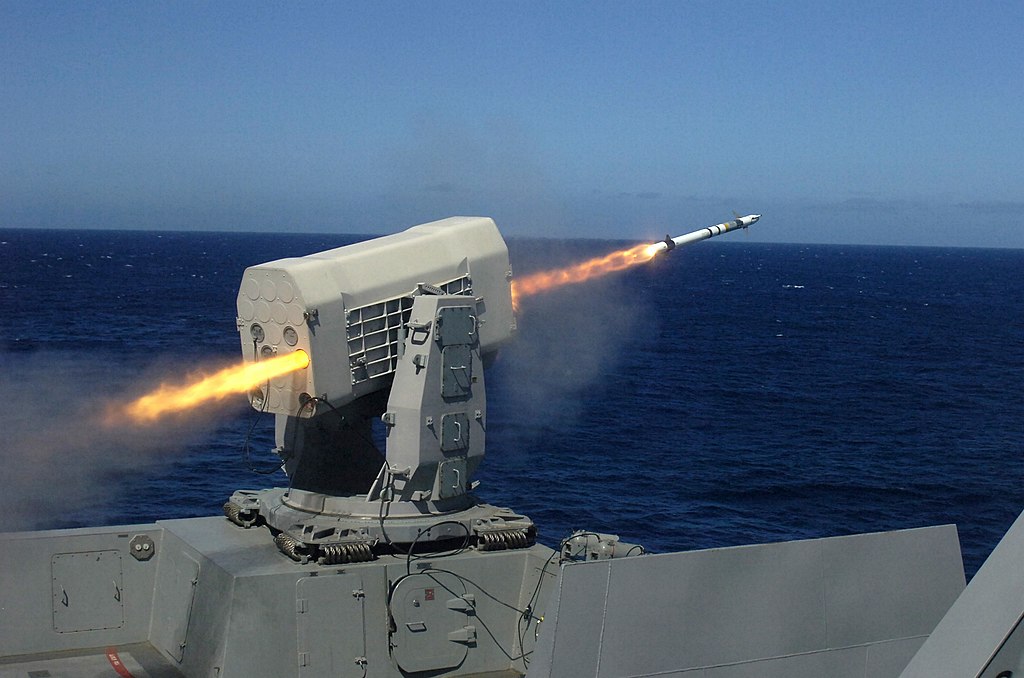
The RIM-116 RAM is a missile-based, Close-In Weapon System (CIWS) developed by the United States and Germany. Its specifications are:
- a length of 2.79 m
- a diameter of 127 mm
- a wingspan of 434 mm
- a speed of Mach 2.0+
- a warhead of 11.3 kg
- a weight of 73.5 kg
- a range of 9 km
The RAM Mk 31 Guided Missile Weapon System (GMWS) consists of the Mk 44 Guided Missile Round Pack (GMRP) and the Mk 49 Guided Missile Launching System (GMLS) with 21 missiles.
The RAM is designed to be flexible in integration with existing platforms and requires no dedicated sensors. All targeting information is provided by various external sensors already fitted on the ship.
The Block 2 RAM is the latest version featuring several upgrades, including:
- a four-axis independent control actuator system
- an increase in rocket motor capability
- double the missile's effective range
- three times increase in maneuverability
- an upgraded passive radio frequency seeker
- can detect Low Probability of Intercept anti-ship missiles
- a digital autopilot
One variant of the Rolling Airframe Missile currently under development is the SeaRAM. The SeaRAM replaces the M601A1 Gatling gun in the Phalanx CIWS with an 11-round launcher.
The SeaRAM is fitted with the sensors of the Phalanx CIWS to create an autonomous system, eliminating the need for external targeting information as in the original RAM.
http://raytheon.mediaroom.com/index.php?s=43&item=2303
Wednesday, March 27, 2013
US funding for MEADS restored
Funding for the Medium Extended Air Defense System (MEADS) that had earlier been cut by the United States Congress has been restored by congressional appropriators, who control the actual funding for arms programs.
Lockheed Martin and US officials had urged them to do so as this move helps prevent termination fees and diplomatic backlash from Germany and Italy, who are partners of the US in the development of MEADS.
The contract calls for the US to pay termination fees that are roughly equal to the $380 million that the US has made available. The last year of funding had been blocked earlier, because it didn't make sense to help fund a program that will not be used by the US.
The United States is currently confronting some cuts in defense spending and MEADS was seen as a good candidate to help reduce spending. However, thanks to some politicians, MEADS is now set to again receive funding.
About $4 billion has already been spent on MEADS, a successor of the Patriot Air Defense System. In the event that the UC withdraws from the program, Lockheed Martin has stated that it intends to keep working on MEADS with Italy and Germany.
MEADS will be tested later this year if it can interecept a ballistic missile target. Lockheed Martin claims MEADS will offer capabilities that the US lacks. It will be cheaper to operate and be able to provide wider coverage.
MEADS is to use the new Patriot Advanced Capability-3 Missile Segment Enhancement (PAC-3 MSE). The PAC-3 MSE is an improved version of the PAC-3 missile, featuring improved manoeuvrability and extended range of up to 50 percent.
In Germany, it may also be complemented by the shorter-range IRIS-T SL missile. This missile is derived from the air-to-air IRIS-T missile, somewhat similar to how the Evolved Sea Sparrow Missile (ESSM) came to be.
Still, even if development of MEADS does get completed, it will find it hard to find widespread adoption in many countries due to competing systems with the possible exception being Germany.
In the US, MEADS will have to compete with the Patriot Defense System, which continues to be constantly upgraded and modernized. In Italy, there is the SAMP/T Air Defense System that has already entered service and performs a similar role as MEADS.
http://www.reuters.com/article/2013/03/25/us-lockheed-missiles-idUSBRE92O02F20130325
Lockheed Martin and US officials had urged them to do so as this move helps prevent termination fees and diplomatic backlash from Germany and Italy, who are partners of the US in the development of MEADS.
The contract calls for the US to pay termination fees that are roughly equal to the $380 million that the US has made available. The last year of funding had been blocked earlier, because it didn't make sense to help fund a program that will not be used by the US.
The United States is currently confronting some cuts in defense spending and MEADS was seen as a good candidate to help reduce spending. However, thanks to some politicians, MEADS is now set to again receive funding.
About $4 billion has already been spent on MEADS, a successor of the Patriot Air Defense System. In the event that the UC withdraws from the program, Lockheed Martin has stated that it intends to keep working on MEADS with Italy and Germany.
MEADS will be tested later this year if it can interecept a ballistic missile target. Lockheed Martin claims MEADS will offer capabilities that the US lacks. It will be cheaper to operate and be able to provide wider coverage.
MEADS is to use the new Patriot Advanced Capability-3 Missile Segment Enhancement (PAC-3 MSE). The PAC-3 MSE is an improved version of the PAC-3 missile, featuring improved manoeuvrability and extended range of up to 50 percent.
In Germany, it may also be complemented by the shorter-range IRIS-T SL missile. This missile is derived from the air-to-air IRIS-T missile, somewhat similar to how the Evolved Sea Sparrow Missile (ESSM) came to be.
Still, even if development of MEADS does get completed, it will find it hard to find widespread adoption in many countries due to competing systems with the possible exception being Germany.
In the US, MEADS will have to compete with the Patriot Defense System, which continues to be constantly upgraded and modernized. In Italy, there is the SAMP/T Air Defense System that has already entered service and performs a similar role as MEADS.
http://www.reuters.com/article/2013/03/25/us-lockheed-missiles-idUSBRE92O02F20130325
Wednesday, March 13, 2013
First IRIS-T SLS Air Defense System Exported to Sweden
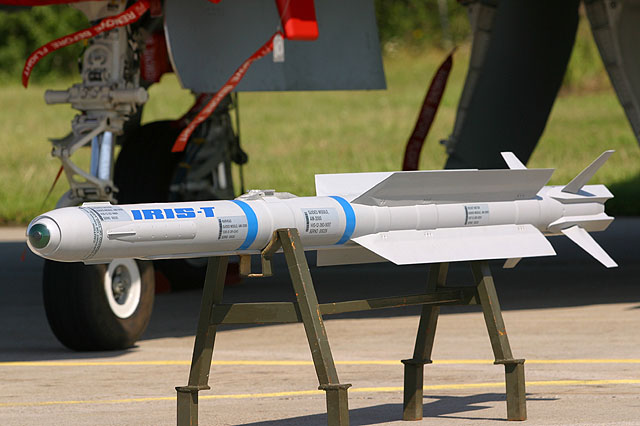
Sweden has become the first country to buy the surface-to-air (SAM) version of the Infra Red Imaging System Tail/Thrust Vector-Controlled (IRIS-T) within visual range air-to-air missile, the IRIS-T SLS.
The contract was signed by the Swedish Defence Material Administration with Diehl Defense for delivery starting in 2016. The IRIS-T missile in already in service in Sweden with the Gripen fighter aircraft. Ten other countries have also acquired the IRIS-T for their air forces.
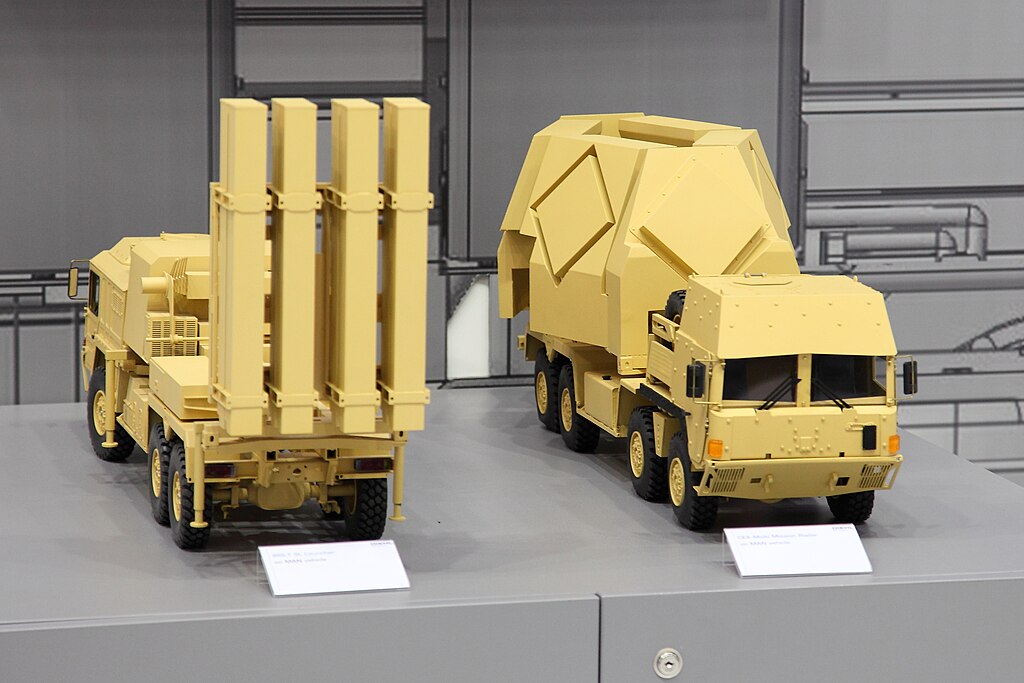
The short range IRIS-T SLS complements the medium range IRIS-T SL / SLM, which has recently been successfully tested for the first time. Both surface launched missiles provide comprehensive air defense, including against aircraft, unmanned aerial vehicles and missiles.
However, while the IRIS-T SLS retains the basic missile body and infrared seeker of the original IRIS-T missile, the IRIS-T SL / SLM features a radar seeker and a heavily modified missile body.
Another variant based on the IRIS-T is the Interactive Defense and Attack System for Submarines (IDAS) now in development. Four IDAS can be fitted inside a magazine and fired directly from a single torpedo tube.
The IDAS missile gives submerged submarines the ability for the first time to engage aerial targets such as anti-submarine warfare (ASW) helicopters, which previously were immune from submarine counter attacks. It can also be used to attack small surface vessels and other coastal targets.
http://www.diehl.com/en/nc/diehl-defence/press/diehl-receives-swedish-air-defence-contract/6.html

The contract was signed by the Swedish Defence Material Administration with Diehl Defense for delivery starting in 2016. The IRIS-T missile in already in service in Sweden with the Gripen fighter aircraft. Ten other countries have also acquired the IRIS-T for their air forces.
The short range IRIS-T SLS complements the medium range IRIS-T SL / SLM, which has recently been successfully tested for the first time. Both surface launched missiles provide comprehensive air defense, including against aircraft, unmanned aerial vehicles and missiles.
However, while the IRIS-T SLS retains the basic missile body and infrared seeker of the original IRIS-T missile, the IRIS-T SL / SLM features a radar seeker and a heavily modified missile body.
Another variant based on the IRIS-T is the Interactive Defense and Attack System for Submarines (IDAS) now in development. Four IDAS can be fitted inside a magazine and fired directly from a single torpedo tube.
The IDAS missile gives submerged submarines the ability for the first time to engage aerial targets such as anti-submarine warfare (ASW) helicopters, which previously were immune from submarine counter attacks. It can also be used to attack small surface vessels and other coastal targets.
http://www.diehl.com/en/nc/diehl-defence/press/diehl-receives-swedish-air-defence-contract/6.html
Tuesday, March 12, 2013
SAMP/T Aster 30 Intercepts Tactical Ballistic Missile Target
The Surface-to-Air Missile Platform/Terrain (SAMP/T) air defense system from Eurosam was again tested against a simulated 300 km range tactical ballistic missile target that was launched from an aircraft.
After the target was acquired by the ARABEL multi-function radar, a Aster 30 B1 missile was fired and scored a direct hit against the target. Two other successful tests had been carried out earlier in 2010 and 2011.
The SAMP/T system is part of the Aster family of surface-to-air missiles (SAM), which are designed for:
The SAMP/T is usually mounted on eight-wheeled trucks with up to eight vertically launched Aster 30 missiles. Each two-stage Aster 30 missile has:
Eurosam has so far delivered 14 SAMP/T units to Italy and France. Ten of those will be deployed in 5 French air defense squadrons, of which 4 are currently equipped or being equipped.
The remaining four SAMP/T units, that have been delivered, currently serve in a single Italian regiment in Mantova. The regiment is to have a total of five units. The SAMP/T may also be exported to Turkey and Singapore.
http://www.mbda-systems.com/mediagallery/#/news/3039

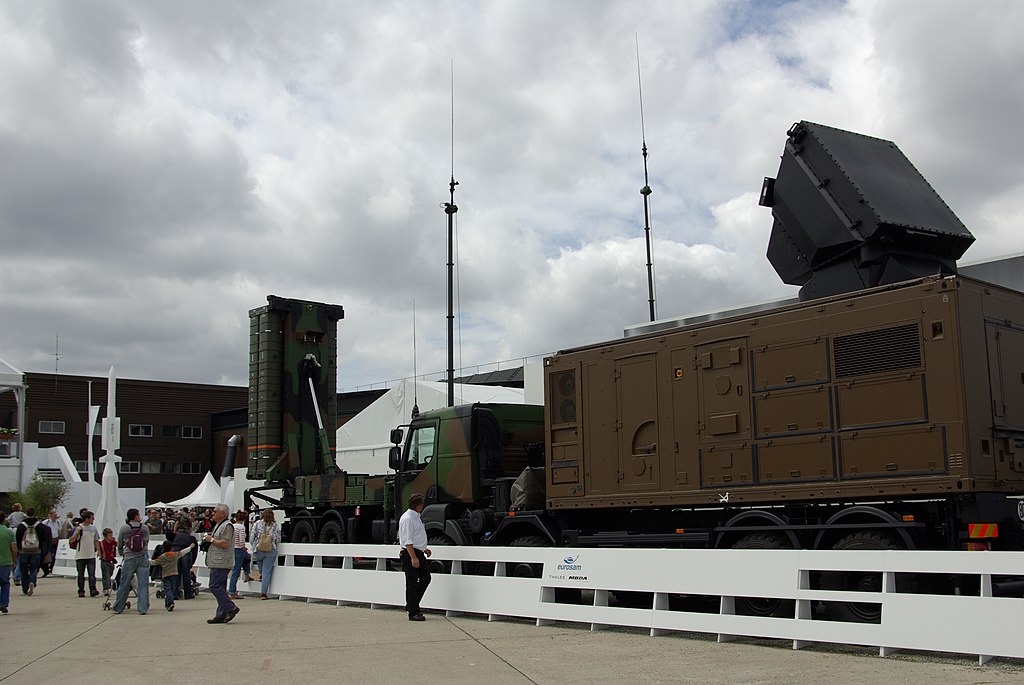
After the target was acquired by the ARABEL multi-function radar, a Aster 30 B1 missile was fired and scored a direct hit against the target. Two other successful tests had been carried out earlier in 2010 and 2011.
The SAMP/T system is part of the Aster family of surface-to-air missiles (SAM), which are designed for:
- Point defense on naval platforms with Aster 15
- Area defense on naval platforms with Aster 30
- Area defense on land platforms with Aster 30
The SAMP/T is usually mounted on eight-wheeled trucks with up to eight vertically launched Aster 30 missiles. Each two-stage Aster 30 missile has:
- a length of 4.9 m
- a weight of 450 kg
- a maximum range of 120 km
- a maximum altitude of 20 km
- a maximum speed of Mach 4.5
Eurosam has so far delivered 14 SAMP/T units to Italy and France. Ten of those will be deployed in 5 French air defense squadrons, of which 4 are currently equipped or being equipped.
The remaining four SAMP/T units, that have been delivered, currently serve in a single Italian regiment in Mantova. The regiment is to have a total of five units. The SAMP/T may also be exported to Turkey and Singapore.
http://www.mbda-systems.com/mediagallery/#/news/3039
Subscribe to:
Posts (Atom)