Australia has decided that it will purchase 58 additional F-35A fighter aircraft on top of the 14 it had already approved to buy earlier. While not a firm contract, this bring the total number of F-35 aircraft it has committed to buy to 72.
While this number is still less than the 100 Australia had originally planned to buy when it became one of the eight partner countries in the F-35 program, the move is welcome news for the F-35 program as there had a slight possibility that the number would have been even less.
The F-18E/F was suggested by some as a viable candidate to replace some of the F-35 aircraft. This would have reduced the number of F-35 to be build and that would in turn raise the cost of the F-35, which is already troubled by escalating costs and other technical problems during development.
Barring future costs increases, the aircraft are expected to cost around $11.5 billion and this makes it the largest commitment to the F-35 program, outside of the United States. The first aircraft are scheduled to be delivered in 2018 and should enter operational service in 2020.
Showing posts with label Australia. Show all posts
Showing posts with label Australia. Show all posts
Tuesday, April 29, 2014

Sunday, May 19, 2013
Australia Looks At Acquiring MQ-4C Triton HALE Unmanned Aerial Vehicle
Australia will soon issue a Letter of Request for the FMS Technical Services Case to the United States for detailed cost and capability information of the Northrop Grumman MQ-4C Triton Unmanned Aerial Vehicle (UAV).
This marks the first step in the path to acquiring possibly up to seven UAVs, which Australia had earlier expressed and again reiterated in its recently released Defense White Paper.
The letter does not signify a purchase and Australia is not obligated to purchase the MQ-4C. It can still select some other option, but the MQ-4C is highly favored by Australia's armed forces.
The MQ-4C Triton is a high-altitude, long-endurance (HALE) UAV developed from the RQ-4 Global Hawk primarily for maritime surveillance. Its specifications are:
To perform its tasks, the MQ-4C Triton is equipped with an array of active and passive sensors, including:
The UAVs are primarily intended to help secure Australia's extended coastline. The UAVs are part of Phase 1B of Project AIR 7000 to be followed by the acquisition of up to eight Boeing P-8A Poseidon maritime patrol aircraft.
This is similar to the US Navy. Both the MQ-4C and P-8A are intended to complement one another as part of the US Navy's Broad Area Maritime Surveillance (BAMS) program.
The MQ-4C Triton is not yet in service, even with the US, but only expected to do so in 2015. The US Navy intends to buy 68 MQ-4C Triton's and 117 P-8A Poseidon's.
http://uk.reuters.com/article/2013/05/16/uk-australia-defence-drone-idUKBRE94F04F20130516

This marks the first step in the path to acquiring possibly up to seven UAVs, which Australia had earlier expressed and again reiterated in its recently released Defense White Paper.
The letter does not signify a purchase and Australia is not obligated to purchase the MQ-4C. It can still select some other option, but the MQ-4C is highly favored by Australia's armed forces.
The MQ-4C Triton is a high-altitude, long-endurance (HALE) UAV developed from the RQ-4 Global Hawk primarily for maritime surveillance. Its specifications are:
- Length: 47.6 ft in (14.5 m)
- Wingspan: 130.9 ft in (39.9 m)
- Height: 15.3 ft in (4.7 m)
- Maximum weight: 32250 lb (14628 kg)
- Maximum speed: 357 mph (575 km/h)
- Maximum range: 9950 nautical miles (18427 km)
- Endurance: 30 hours
- Service ceiling: 60000 ft (18288 m)
To perform its tasks, the MQ-4C Triton is equipped with an array of active and passive sensors, including:
- 360-degree Field Of Regard (FOR) sensors
- Multi-Function Active Sensor (MFAS) Maritime Radar
- Electro-Optical / Infrared (EO/IR) sensor
- Automatic Identification System (AIS) receiver
- Electronic Support Measures (ESM)
- Communications relay capability
- beyond line of sight and line of sight communications
The UAVs are primarily intended to help secure Australia's extended coastline. The UAVs are part of Phase 1B of Project AIR 7000 to be followed by the acquisition of up to eight Boeing P-8A Poseidon maritime patrol aircraft.
This is similar to the US Navy. Both the MQ-4C and P-8A are intended to complement one another as part of the US Navy's Broad Area Maritime Surveillance (BAMS) program.
The MQ-4C Triton is not yet in service, even with the US, but only expected to do so in 2015. The US Navy intends to buy 68 MQ-4C Triton's and 117 P-8A Poseidon's.
http://uk.reuters.com/article/2013/05/16/uk-australia-defence-drone-idUKBRE94F04F20130516

Saturday, May 11, 2013
Australia Will Receive One Extra MRH90 Free As Compensation
Australia will receive an additional MRH90 helicopter from Eurocopter, a subsidiary of European Aeronautic, Defense & Space (EADS), as compensation for delays in delivery of the helicopters.
The MRH90 or NH90 Multi-Role Helicopter (MRH) is a medium-sized, twin-engined, transport helicopter that is piloted by a crew of 2. It has a maximum payload of up to 4000 kg, including room for up to 20 soldiers.
The MRH90 is a variant of the NH90 Tactical Transport Helicopter (TTH) for Australia. The extra helicopter from Eurocopter brings the total number of MRH90 to be acquired by Australia to 47.
Australia ordered 12 MRH90 in 2005 and an additional 34 in 2006 to replace existing Westland Sea King, Bell UH-1 Iroquois and Sikorsky UH-60 Black Hawk helicopters in the Australian Army and Navy.
Four were to be delivered from Europe and the remaining manufactured locally under license. Australia currently has 19 MRH90 and will receive 6 to 7 more every year until 2017.
However, the original program schedule has been delayed by 3 years due to problems, including those associated with the RTM322 engine in the MRH90, that appeared in Australia.
Australian Aerospace, a subsidiary of Eurocopter that manufactures the MRH90, hopes to make up for these delays by providing the 47th MRH90 free of charge to Australia.
The problems with the MRH90 helped lead Australia to choose the Sikorsky MH-60R Sea Hawk over the NH90 NATO Frigate Helicopter (NFH), a variant of the NH90 for naval use, including Anti-Submarine Warfare (ASW).
Australia awarded a $3.15 billion contract for 24 MH-60R in 2011 to replace older S-70B Sea Hawk helicopters in service. All are to be delivered between 2014 and 2020.
http://www.bloomberg.com/news/2013-05-09/eurocopter-gives-australia-free-nh90-chopper-to-atone-for-delay.html

The MRH90 or NH90 Multi-Role Helicopter (MRH) is a medium-sized, twin-engined, transport helicopter that is piloted by a crew of 2. It has a maximum payload of up to 4000 kg, including room for up to 20 soldiers.
The MRH90 is a variant of the NH90 Tactical Transport Helicopter (TTH) for Australia. The extra helicopter from Eurocopter brings the total number of MRH90 to be acquired by Australia to 47.
Australia ordered 12 MRH90 in 2005 and an additional 34 in 2006 to replace existing Westland Sea King, Bell UH-1 Iroquois and Sikorsky UH-60 Black Hawk helicopters in the Australian Army and Navy.
Four were to be delivered from Europe and the remaining manufactured locally under license. Australia currently has 19 MRH90 and will receive 6 to 7 more every year until 2017.
However, the original program schedule has been delayed by 3 years due to problems, including those associated with the RTM322 engine in the MRH90, that appeared in Australia.
Australian Aerospace, a subsidiary of Eurocopter that manufactures the MRH90, hopes to make up for these delays by providing the 47th MRH90 free of charge to Australia.
The problems with the MRH90 helped lead Australia to choose the Sikorsky MH-60R Sea Hawk over the NH90 NATO Frigate Helicopter (NFH), a variant of the NH90 for naval use, including Anti-Submarine Warfare (ASW).
Australia awarded a $3.15 billion contract for 24 MH-60R in 2011 to replace older S-70B Sea Hawk helicopters in service. All are to be delivered between 2014 and 2020.
http://www.bloomberg.com/news/2013-05-09/eurocopter-gives-australia-free-nh90-chopper-to-atone-for-delay.html

Saturday, May 4, 2013
Australia Intends to Acquire F-35 and EA-18G in 2013 Defense White Paper
Australia is still committed to the F-35 Lightning II in the 2013 Defense White Paper just released. The White Paper details the outlook in defense matters from Australia's point of view.
Australia does not rule out the possibility of still acquiring up to 100 F-35 fighter aircraft as originally intended, although this number may be reduced to just three fourth with an option for the remaining one fourth.
Australia's commitment to the Lockheed Martin F-35 had been in doubt, especially after the acquisition of 24 F/A-18E/F Super Hornet and the possibility of another 12 F/A-18E/F and 12 EA-18G Growler aircraft.
These purchases make it unlikely Australia will still acquire all of the 100 F-35 fighters. However, in the White Paper, only the purchase of 12 EA-18G electronic warfare aircraft from Boeing is confirmed.
Australia would become the only country outside of the United States to operate the Growler. The cost of these aircraft is estimated at $1.5 billion and would take 4 years to complete.
These 12 together with the 24 F/A-18E/F already in service would be joined by the F-35, which is scheduled to enter squadron service in 2020. By 2030, the Super Hornet could be replaced by exercising the option for the remaining F-35 jets.
Other notable highlights of the White Paper include:
It's important to note that the policy laid out in a White Paper is not set in stone. A new government could opt for a new strategy, which will be laid out in a new White Paper.
http://www.defence.gov.au/whitepaper2013/

Australia does not rule out the possibility of still acquiring up to 100 F-35 fighter aircraft as originally intended, although this number may be reduced to just three fourth with an option for the remaining one fourth.
Australia's commitment to the Lockheed Martin F-35 had been in doubt, especially after the acquisition of 24 F/A-18E/F Super Hornet and the possibility of another 12 F/A-18E/F and 12 EA-18G Growler aircraft.
These purchases make it unlikely Australia will still acquire all of the 100 F-35 fighters. However, in the White Paper, only the purchase of 12 EA-18G electronic warfare aircraft from Boeing is confirmed.
Australia would become the only country outside of the United States to operate the Growler. The cost of these aircraft is estimated at $1.5 billion and would take 4 years to complete.
These 12 together with the 24 F/A-18E/F already in service would be joined by the F-35, which is scheduled to enter squadron service in 2020. By 2030, the Super Hornet could be replaced by exercising the option for the remaining F-35 jets.
Other notable highlights of the White Paper include:
- Australia still seeks to build up to 12 diesel-electric submarines. These will either be derived from the Collins class or an entirely new submarine design. Australia will not consider existing submarine designs currently available as none of them fits Australia's needs.
- The acquisition of a fourth Air Warfare Destroyer will not be considered at this point. Australia is acquiring 3 Hobart class Air Warfare Destroyers, equipped with the Aegis system, with the first to be commissioned in 2016.
- Australia intends to buy around 7 maritime versions of the Northrop Grumman RQ-4 Global Hawk / MQ-4C Triton for long-range surveillance to protect offshore resources.
- Australia will replace both the HMAS Sirius and HMAS Success with new supply ships.
- Australia will look for a replacement for the Armidale class patrol boats.
It's important to note that the policy laid out in a White Paper is not set in stone. A new government could opt for a new strategy, which will be laid out in a new White Paper.
http://www.defence.gov.au/whitepaper2013/

Wednesday, March 6, 2013
Australia May Buy 12 F/A-18E/F Super Hornet and 12 E/A-18G Growler Aircraft
The Defense Security Cooperation Agency (DSCA) has notified the United States Congress of a possible sale of 12 multi-role F/A-18E/F Super Hornet fighter aircraft and 12 E/A-18G Growler electronic warfare aircraft to Australia.
The total value of the US Foreign Military Sales contract, including associated equipment, parts, training, and logistical support would amount to roughly $3.7 billion.
If the aircraft are indeed acquired, they would join 24 two-seat F/A-18F already in service and another 71 of the older F/A-18, which are now in the process of being upgraded.
Those Super Hornet aircraft were originally acquired as a gap filler between the retirement of the F-111 in 2010 and the arrival of the F-35 in 2014. Delays and other F-35 problems have now postponed this schedule by several years.
Australia had been expected to acquire 100 F-35, but that number is now in doubt and may be reduced substantially. This has already happened in other countries such as Italy, which has already cut the number of F-35 it plans to acquire.
Australia is also one of the eight partner countries of the US in the F-35 program. By helping fund development of the F-35, it is entitled to a share of the work worth billions.
The Boeing F/A-18E/F Super Hornet is an enlarged version of the F/A-18 and has:
The EA-18G Growler is a specialized electronic warfare version of the two-seat F/A-18F, which can be fitted with:
http://www.dsca.mil/pressreleases/36-b/2013/Australia_13-05.pdf
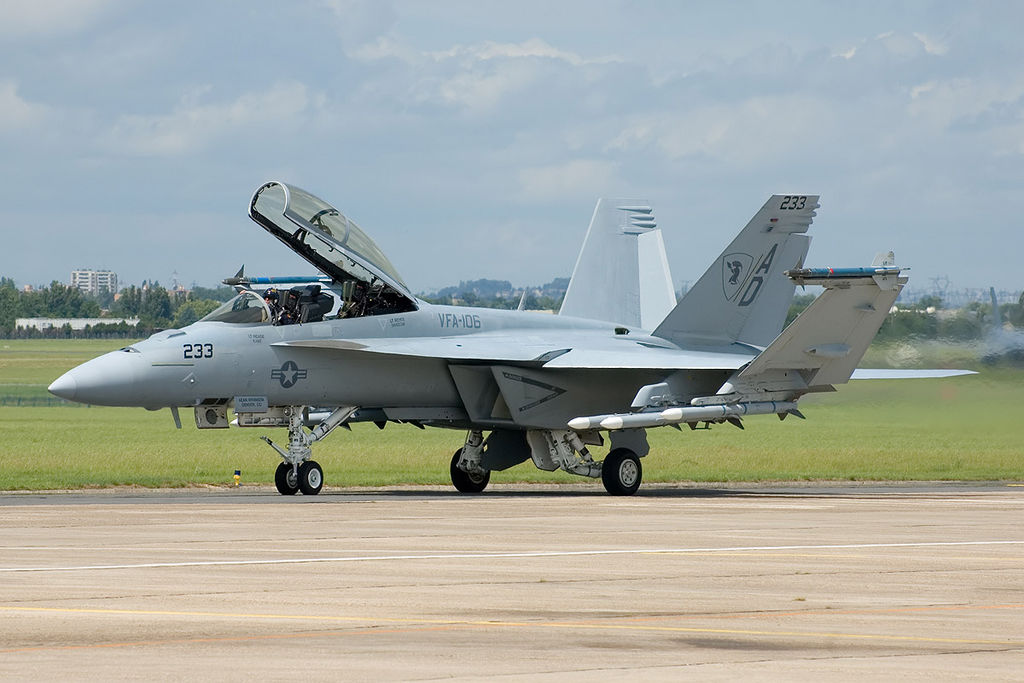

The total value of the US Foreign Military Sales contract, including associated equipment, parts, training, and logistical support would amount to roughly $3.7 billion.
If the aircraft are indeed acquired, they would join 24 two-seat F/A-18F already in service and another 71 of the older F/A-18, which are now in the process of being upgraded.
Those Super Hornet aircraft were originally acquired as a gap filler between the retirement of the F-111 in 2010 and the arrival of the F-35 in 2014. Delays and other F-35 problems have now postponed this schedule by several years.
Australia had been expected to acquire 100 F-35, but that number is now in doubt and may be reduced substantially. This has already happened in other countries such as Italy, which has already cut the number of F-35 it plans to acquire.
Australia is also one of the eight partner countries of the US in the F-35 program. By helping fund development of the F-35, it is entitled to a share of the work worth billions.
The Boeing F/A-18E/F Super Hornet is an enlarged version of the F/A-18 and has:
- a length of 18.31 m
- a wingspan of 13.62 m
- a height of 4.88 m
- an empty weight of 14550 kg
- a maximum takeoff weight of 29940 kg
The EA-18G Growler is a specialized electronic warfare version of the two-seat F/A-18F, which can be fitted with:
- AN/APG-79 Active Electronically Scanned Array radar
- AN/ALQ-218 wideband receivers on the wingtips
- ALQ-99 high and low-band jamming pods
- AIM-120 AMRAAM missiles
- AGM-88 HARM missiles
http://www.dsca.mil/pressreleases/36-b/2013/Australia_13-05.pdf
Monday, January 14, 2013
US Report Details Unresolved Issues With F-35 Program
An 18 page Pentagon report recently sent to the United States Congress has provided some details about the current state of the F-35 fighter Lightning II program, which at $396 billion makes it the most expensive weapons program in the history of the United States.
Lockheed Martin, the prime contractor, is to build 3 different models of the F-35 fighter for the United States, which plans to purchase 2443 of the aircraft. In addition, the plane will likely be acquired by eight other nations that helped pay for its development, including:
http://news.yahoo.com/pentagon-report-cites-lack-maturity-lockheed-f-35-012237872--finance.html


Lockheed Martin, the prime contractor, is to build 3 different models of the F-35 fighter for the United States, which plans to purchase 2443 of the aircraft. In addition, the plane will likely be acquired by eight other nations that helped pay for its development, including:
- Australia,
- Canada,
- Denmark,
- Italy,
- the Netherlands,
- Norway,
- Turkey,
- the United kingdom
- the program has completed a third or 20,000 of all planned test flights and has 39,579 left to go
- certain tests planned for 2012 by Lockheed Martin were not accomplished, but overall the number of tests completed in 2012 of 1092 exceeded the number planned of 927 by performing some future tests earlier
- the F-35A completed 30 percent less tests than planned due to problems with the weapon bay doors, operating limits of the aircraft and problems with the air refuelling system, which required new instrumentation
- the F-35B for the Marine Corps has issues with the engine lift fan built by Rolls Royce, a supplier to the engine maker, Pratt & Whitney, a unit of United Technologies Corp
- durability testing of the F-35B had to be halted after multiple cracks were found on the underside of the plane's fuselage
- the F-35C has problems with the ability to transfer video and imagery data to ships and a potentially serious problem with the coolant system
- during high-speed, high-altitude flights, the stealthy coatings peeled off on horizontal tail surfaces due to higher-than-expected temperatures
- software packages from Lockheed Martin needed to support flight tests were delayed or not complete when delivered
- both the advanced helmet and the computerized logistics system have issues that remain unresolved
- weapons integration testing has been delayed by numerous factors, including problems with radar performance
- flight operations are currently banned within 25 miles of known lightning conditions due to issues with the system that protects the plane from fuel tank explosions caused by lightning
- the mean time between critical failures has increased and the aircraft weight has remained steady, but the aircraft's performance remains below the level expected at this point in time
http://news.yahoo.com/pentagon-report-cites-lack-maturity-lockheed-f-35-012237872--finance.html
Saturday, January 12, 2013
India again selects A330 MRTT Multi Role Tanker Transport aircraft
India has again selected Airbus Military as the preferred bidder to supply its A330 MRTT Multi Role Tanker Transport to the Indian Air Force (IAF) after a long and thorough selection process, which resulted in a prior selection being cancelled in 2010. The Ilyushin IL-78MK from Russia was the losing candidate in the competition.
A contract for the supply of 6 aircraft in 2013, as expected, would bring the number exported to 34 and make India the fifth country to use the A330 MRTT aircraft, following:
The wide-body Airbus Military A330 MRTT aircraft can be used both as a tanker and transport aircraft and is derived from the civilian A330-200 airliner. It supports both the Boom Refuelling system and Hose and Drogue Pod Refuelling system.
As a transport aircraft, the A330 MRTT can carry up to 300 troops or a payload of up to 45 ton. It can also function in the Medical Evacuation (MEDEVAC) role with room for 130 stretchers.
Specifications
Crew: 3
Length: 58.80 m
Wingspan: 60.3 m
Height: 17.4 m
Maximum speed: 880 km/h
Cruise speed: 860 km/h
Range: 14800 km
Service ceiling: 12600 m
Empty weight: 125000 kg
Useful load: 45000 kg non-fuel payload
Max takeoff weight: 233000 kg
Powerplant: 2× Rolls-Royce Trent 772B or General Electric CF6-80E1A4 or Pratt & Whitney PW 4168A turbofans, 320 kN (72,000 lbf) each
Fuel Capability: 111000 kg max, 65,000 kg at 1000 nmi with 2 hours on station
http://www.airbusmilitary.com/LatestNews/tabid/176/ArticleID/234/ArtMID/681/Airbus-Military-A330-MRTT-selected-by-Indian-Government-.aspx

A contract for the supply of 6 aircraft in 2013, as expected, would bring the number exported to 34 and make India the fifth country to use the A330 MRTT aircraft, following:
- Australia order for 5 of which 4 have been delivered,
- Saudi Arabia ordered 6,
- the United Arab Emirates ordered 3,
- the United Kingdom ordered 14 with 1 delivered.
The wide-body Airbus Military A330 MRTT aircraft can be used both as a tanker and transport aircraft and is derived from the civilian A330-200 airliner. It supports both the Boom Refuelling system and Hose and Drogue Pod Refuelling system.
As a transport aircraft, the A330 MRTT can carry up to 300 troops or a payload of up to 45 ton. It can also function in the Medical Evacuation (MEDEVAC) role with room for 130 stretchers.
Specifications
Crew: 3
Length: 58.80 m
Wingspan: 60.3 m
Height: 17.4 m
Maximum speed: 880 km/h
Cruise speed: 860 km/h
Range: 14800 km
Service ceiling: 12600 m
Empty weight: 125000 kg
Useful load: 45000 kg non-fuel payload
Max takeoff weight: 233000 kg
Powerplant: 2× Rolls-Royce Trent 772B or General Electric CF6-80E1A4 or Pratt & Whitney PW 4168A turbofans, 320 kN (72,000 lbf) each
Fuel Capability: 111000 kg max, 65,000 kg at 1000 nmi with 2 hours on station
http://www.airbusmilitary.com/LatestNews/tabid/176/ArticleID/234/ArtMID/681/Airbus-Military-A330-MRTT-selected-by-Indian-Government-.aspx
Subscribe to:
Posts (Atom)