The INS Rahav, the second of the Dolphin II class diesel-powered submarines was handed over in Germany to the Israeli Navy. Some equipment still needs to be installed, but it is expected to arrive in Israel sometime in late 2013 or early 2014.
Similar to its predecessors, the Dolphin II class submarines were designed specifically for Israel and are loosely based on the German Type 212 submarines. However, the Dolphin II submarines are much larger with many modifications.
The three earlier Dolphin I class submarines were also based on the Type 209 submarines but larger. Israel only had to pay for half on the third Dolphin I submarine, while the rest and the first two submarines were granted free of charge to Israel by Germany during the nineties.
Israel order two Dolphin II submarines in 2006 and ordered another one in 2011. The total cost is estimated at over $2 billion of which Israel will pay about three fourth and the rest by Germany. Israel received the first Dolphin II class submarine, the Tannin, in 2012.
The Dolphin class submarines are build by Howaldtswerke-Deutsche Werft AG (HDW) for Israel. No other country operates either the Dolphin I or Dolphin II class submarines.
The Dolphin II class submarines are equipped with Air Independent Propulsion (AIP) similar to those on the Type 212 to remain submerged for longer periods of time. The German version of AIP relies on fuel cells, unlike those of some other countries that use a different method.
The Dolphin class submarines are rare in that they are equipped with 650 mm torpedo tubes in addition to the 533 mm torpedo tubes. Normally, 650 mm torpedo tubes are only found on some Russian nuclear attack submarines and can fire much larger weapons with longer range.
It is thought that the primary use of the Dolphin submarines to Israel is to house their nuclear deterrent using long-range cruise missiles fired from under water using the larger torpedo tubes.
Israel being a relatively small country that is surrounded by hostile states at very close range makes it vulnerable to a surprise attack. The Dolphin submarines are believed to be less vulnerable and hence take a prominent role in ensuring the security of Israel.
http://rt.com/news/israel-dolphin-submarine-nuclear-598/
Showing posts with label Israel. Show all posts
Showing posts with label Israel. Show all posts
Wednesday, May 1, 2013

Sunday, April 21, 2013
Major Arms Deal in The Works Between The US, Israel, Saudi Arabia and the United Arab Emirates
A major arms deal is in the works between the United States, Israel, the United Arab Emirates and Saudi Arabia. The total value of all contracts is estimated at around $10 billion.
The deal is expected to be the main topic of discussion when US Defense Secretary Chuck Hagel visits the three countries starting in April 21. The arms purchases are intended to strengthen the armed forces of US allies in the Middle East against potential threats in the region.
Exact details are yet to be determined, but may include the following:
Israel receives billions of dollars in military aid each year from the United States, which presumably will be used to pay for the arms purchases. Both Saudi Arabia and the United Arab Emirates are major buyers of US weapons with major contracts signed in recent years.
In 2011, Saudi Arabia signed a $30 billion contract with the United States that included 84 Boeing F-15SA fighter jets, upgrade of 68 older F-15S to the SA standard, and 72 UH-60 Black Hawk helicopters. The first F-15SA is expected to be delivered in 2013.
In 2011, the United Arab Emirates ordered the Terminal High-Altitude Area Defense (THAAD) air defense system in a $3.49 billion deal to become the first country outside the United States to do so.
http://www.bloomberg.com/news/2013-04-19/u-s-to-announce-10-billion-arms-sale-in-middle-east.html


The deal is expected to be the main topic of discussion when US Defense Secretary Chuck Hagel visits the three countries starting in April 21. The arms purchases are intended to strengthen the armed forces of US allies in the Middle East against potential threats in the region.
Exact details are yet to be determined, but may include the following:
- Sale of the V-22 Osprey tilt-rotor aircraft to Israel. This would mark the first time the V-22 has been exported abroad.
- Sale of KC-135 refuelling aircraft to the Israeli Air Force. Israel currently does not operate any.
- Sale of 26 new F-16 fighter aircraft to the United Arab Emirates. The UAE has already ordered 80 F-16 Block 60, the most advanced version of the F-16 currently available.
- Possible sale to Saudi Arabia of the Advanced Anti-Radiation Guided Missile (AARGM), the latest version of the High-Speed Anti-Radar Missile (HARM) for suppression of enemy air defenses.
Israel receives billions of dollars in military aid each year from the United States, which presumably will be used to pay for the arms purchases. Both Saudi Arabia and the United Arab Emirates are major buyers of US weapons with major contracts signed in recent years.
In 2011, Saudi Arabia signed a $30 billion contract with the United States that included 84 Boeing F-15SA fighter jets, upgrade of 68 older F-15S to the SA standard, and 72 UH-60 Black Hawk helicopters. The first F-15SA is expected to be delivered in 2013.
In 2011, the United Arab Emirates ordered the Terminal High-Altitude Area Defense (THAAD) air defense system in a $3.49 billion deal to become the first country outside the United States to do so.
http://www.bloomberg.com/news/2013-04-19/u-s-to-announce-10-billion-arms-sale-in-middle-east.html


Wednesday, April 17, 2013
Israel's Iron Dome Air Defense System to receive additional funding from the United States
The Missile Defense Agency (MDA) from the United States is requesting $220 million for Fiscal Year 2014, which begins October 1, and $175.9 million for Fiscal Year 2015. The funds are intended to purchase Iron Dome air defense systems for Israel.
Pending approval, the funds would add to the $486 million that has already been allocated in recent years to the Iron Dome system, which is made by the Israeli Rafael Advanced Defense Systems. For the current fiscal year, $211 million has been allocated.
The allocation of precious funding to Israel comes at a time when several sections of the US Armed Forces have or will see some of their budgets cut. This has led to negative consequences, such as:
The Iron Dome system is designed to provide air defense, especially against short-range rockets and artillery shells, for civilian population centers. The system is already in service and has been used in recent conflicts.
According to Israel, the Iron Dome system has performed exceptionally well in intercepts and attained accuracy figures that are unmatched anywhere by any other system.
These claims have been disputed with some suggesting that the real accuracy figures are only a fraction of what is claimed by Israel. The Israeli government has dismissed these criticisms.
However, regardless of the true effectiveness of the Iron Dome system, the real question remains whether it makes sense to invest in a system, which uses missiles that are much more expensive than the unguided rockets and shells it's supposed to intercept.
In a war of attrition, the economics are overwhelmingly against the side using the Iron Dome system. From this standpoint and the fact that unguided rockets and shells will always have the price advantage, the Iron Dome as it's currently conceived, is fundamentally flawed.
http://www.bloomberg.com/news/2013-04-16/pentagon-seeks-220-million-for-israel-s-iron-dome-system.html

Pending approval, the funds would add to the $486 million that has already been allocated in recent years to the Iron Dome system, which is made by the Israeli Rafael Advanced Defense Systems. For the current fiscal year, $211 million has been allocated.
The allocation of precious funding to Israel comes at a time when several sections of the US Armed Forces have or will see some of their budgets cut. This has led to negative consequences, such as:
- layoffs and hiring freezes
- suspension of tuition assistance to service members
- delays in medical care
- reduced flying hours for pilots
The Iron Dome system is designed to provide air defense, especially against short-range rockets and artillery shells, for civilian population centers. The system is already in service and has been used in recent conflicts.
According to Israel, the Iron Dome system has performed exceptionally well in intercepts and attained accuracy figures that are unmatched anywhere by any other system.
These claims have been disputed with some suggesting that the real accuracy figures are only a fraction of what is claimed by Israel. The Israeli government has dismissed these criticisms.
However, regardless of the true effectiveness of the Iron Dome system, the real question remains whether it makes sense to invest in a system, which uses missiles that are much more expensive than the unguided rockets and shells it's supposed to intercept.
In a war of attrition, the economics are overwhelmingly against the side using the Iron Dome system. From this standpoint and the fact that unguided rockets and shells will always have the price advantage, the Iron Dome as it's currently conceived, is fundamentally flawed.
http://www.bloomberg.com/news/2013-04-16/pentagon-seeks-220-million-for-israel-s-iron-dome-system.html

Tuesday, February 26, 2013
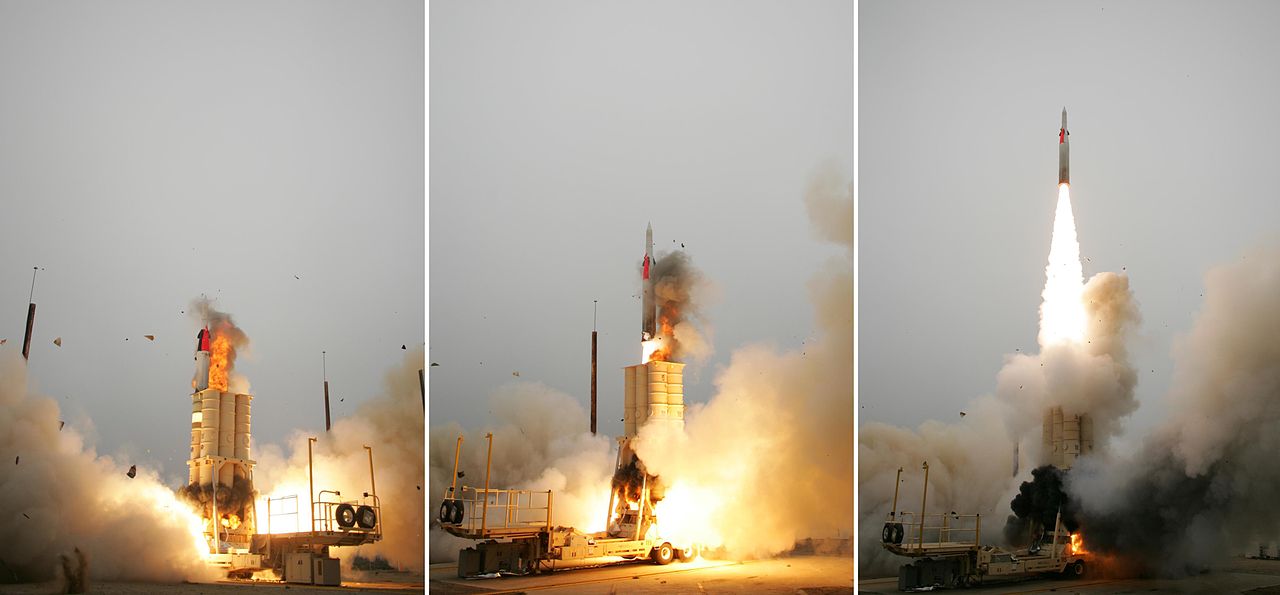
Arrow 3 missile interceptor tested for the first time in Israel
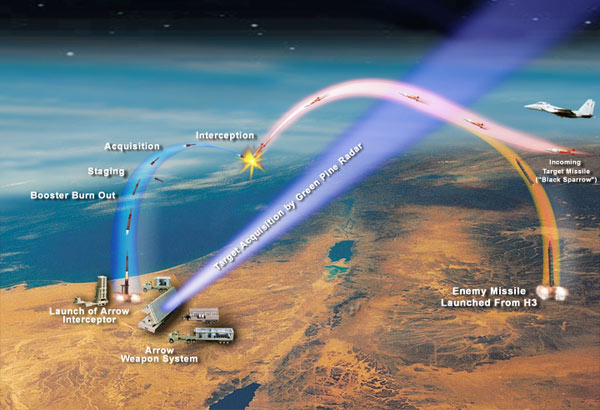
Israel has tested for the first time the Arrow 3 anti-missile interceptor. The Arrow 3 is the latest version of the Arrow missile program that is jointly being developed and funded by the United States and its Missile Defense Agency.
The primary contractors are Israel Aerospace Industries (IAI) and Boeing, which is also the lead contractor of the Ground Based Interceptor (GBI) program in the US.
The test did not involve a target, but a full exoatmospheric test is planned for the future. The Arrow missile forms the upper layer of Israel's multi-layered missile defense. It is complemented at lower altitudes by David's Sling and the Iron Dome.
Unlike its predessor, the Arrow 2, which destroys its target with a proximity warhead, the Arrow 3 destroys its target with a kinetic collision or hit-to-kill technology.
The Arrow 3 will be lighter and smaller than the Arrow 2, while also being faster and able to engage targets at higher altitudes.
The two-stage, solid-fueled Arrow 2 which has served Israel since 2000, has:
Israel is currently the only country operating the Arrow system. Attempts by India to acquire the Arrow 2 from Israel were rejected by the US as joint partner of the Arrow program.
However, India was able to acquire components of the system, such as the Active Electronically Scanned Array (AESA) EL/M-2080 Green Pine radar system in 2005, which can detect targets at a range of up to 500 km.
http://www.bbc.co.uk/news/world-middle-east-21571422


The primary contractors are Israel Aerospace Industries (IAI) and Boeing, which is also the lead contractor of the Ground Based Interceptor (GBI) program in the US.
The test did not involve a target, but a full exoatmospheric test is planned for the future. The Arrow missile forms the upper layer of Israel's multi-layered missile defense. It is complemented at lower altitudes by David's Sling and the Iron Dome.
Unlike its predessor, the Arrow 2, which destroys its target with a proximity warhead, the Arrow 3 destroys its target with a kinetic collision or hit-to-kill technology.
The Arrow 3 will be lighter and smaller than the Arrow 2, while also being faster and able to engage targets at higher altitudes.
The two-stage, solid-fueled Arrow 2 which has served Israel since 2000, has:
- a length of 680 mm
- a winspan of 820 mm
- a weight of 2800 kg
- a warhead of 150 kg
- a maximum speed of Mach 9
- a maximum ceiling of 60 km
Israel is currently the only country operating the Arrow system. Attempts by India to acquire the Arrow 2 from Israel were rejected by the US as joint partner of the Arrow program.
However, India was able to acquire components of the system, such as the Active Electronically Scanned Array (AESA) EL/M-2080 Green Pine radar system in 2005, which can detect targets at a range of up to 500 km.
http://www.bbc.co.uk/news/world-middle-east-21571422
Monday, December 17, 2012
Israel orders 6900 JDAM kits in $647 million deal with US
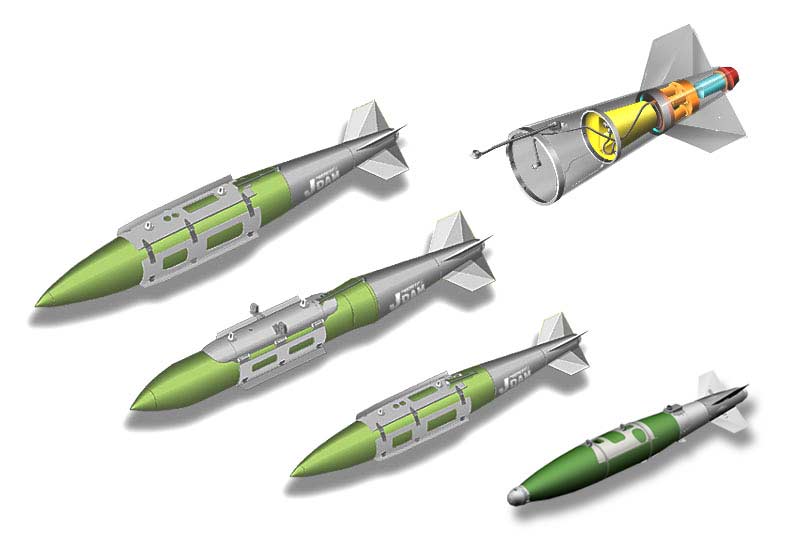
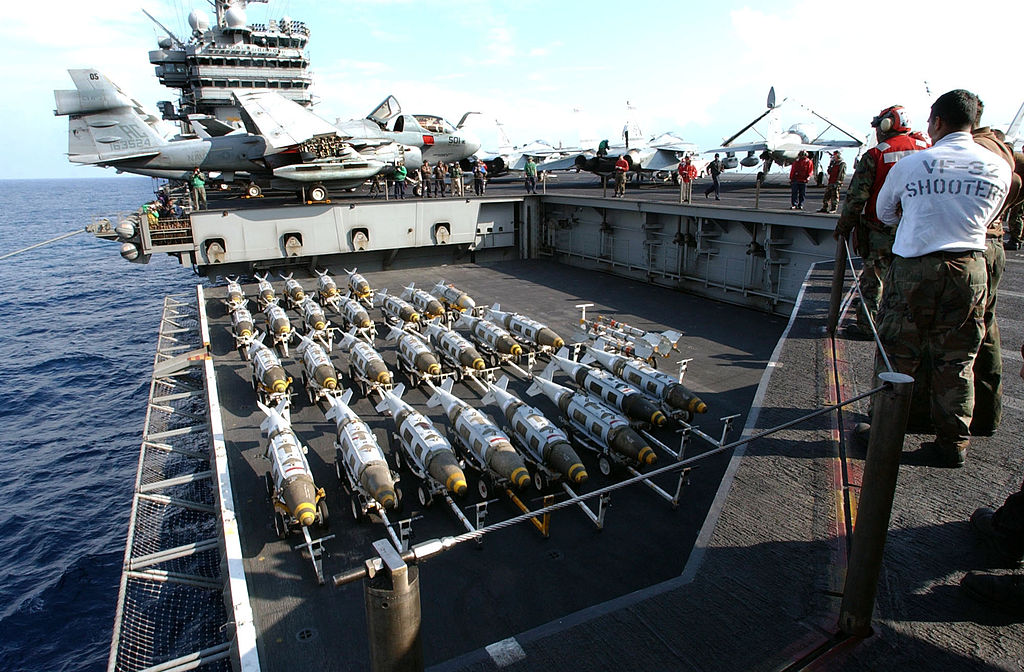
Israel has placed a $647 million order of Joint Direct Attack Munition (JDAM) tail kits and associated parts with the United States. The package includes:
Manufactured by Boeing and Lockheed, the JDAM is a low-cost guidance kit designed to convert existing 500lb, 1,000lb and 2,000lb unguided free-fall bombs into precision guided smart munitions.
The kit consists of adjustable tail fins and an inertial navigation system / global positioning system control unit, capable of accurately delivering bombs from very low to very high altitude in all-weather conditions.
http://www.haaretz.com/news/diplomacy-defense/u-s-to-sell-israel-munitions-to-renew-stock-after-operation-pillar-of-defense.premium-1.484114


- 3,450 JDAM anti-jam KMU-556 (GBU-31) for MK-84 warheads
- 1,725 KMU-557 (GBU-31) for BLU-109 warheads
- 1,725 KMU-572 (GBU-38) for MK-82 warheads
- 3,450 MK-84 2,000lb general purpose bombs
- 1,725 MK-82 500lb general purpose bombs
- 1,725 BLU-109 bombs
- 3,450 GBU-39 small diameter bombs
- 11,500 FMU-139, FMU-143 and FMU-152 fuses
Manufactured by Boeing and Lockheed, the JDAM is a low-cost guidance kit designed to convert existing 500lb, 1,000lb and 2,000lb unguided free-fall bombs into precision guided smart munitions.
The kit consists of adjustable tail fins and an inertial navigation system / global positioning system control unit, capable of accurately delivering bombs from very low to very high altitude in all-weather conditions.
http://www.haaretz.com/news/diplomacy-defense/u-s-to-sell-israel-munitions-to-renew-stock-after-operation-pillar-of-defense.premium-1.484114

Subscribe to:
Posts (Atom)